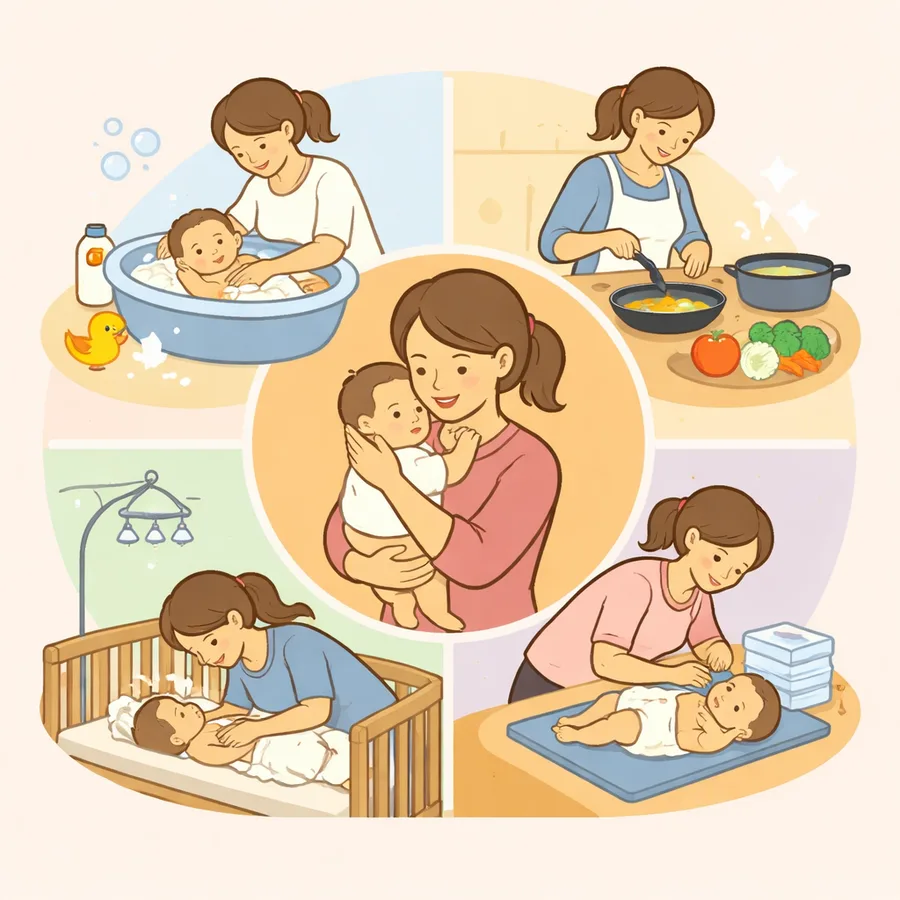


That first moment you hold your baby
Most new parents feel the same thing when they hold their newborn for the first time: “Can I really take care of something this tiny and fragile?” That anxiety is completely normal. This guide shares newborn care know-how from professional postpartum caregivers in the U.S. who have cared for hundreds of babies.
1. Understanding Your Newborn’s World

Average Newborn Size
5.5–8.8lbs
Average Weight
(2.5–4.0 kg)
18–21in
Average Length
(46–53 cm)
13–14.5in
Head Circumference
(33–37 cm)
A Newborn’s Typical Day
😴 Sleep
- 14–17 hours of sleep per day
- Wakes every 2–4 hours
- Cannot tell day from night (first few weeks)
- Light sleep means frequent waking
🍼 Feeding
- Feeds every 2–3 hours
- Each session takes 10–45 minutes
- 8–12 feedings per day
- More frequent during growth spurts
🚼 Diapers
- 8–12 wet diapers per day
- 3–4 dirty diapers per day (more with breastfeeding)
- First few days: dark meconium stool
- Gradually transitions to yellow, soft stool
😢 Crying
- 1–3 hours of crying per day is normal
- Crying is a newborn’s only way to communicate
- Evening hours tend to be fussier (colic)
2. Safe Holding and Handling
3 Basic Holding Positions
🤱 Cradle Hold
- Support baby’s head and neck with one arm
- Support the bottom with the other arm
- Hold baby close to your chest
- Keep baby’s face visible
✅ Best for: Comfortable, stable hold with eye contact
⚠️ Note: Your arm may tire with extended use
🏈 Football Hold
- Tuck baby under your arm like a football
- Support the head and neck with your hand
- Baby’s body runs along your forearm
- Baby faces up, looking at you
✅ Best for: Nursing and burping
⚠️ Note: One hand is always occupied
💆 Shoulder Hold
- Hold baby upright against your chest
- Rest baby’s head on your shoulder
- One hand supports head and neck
- Other hand supports the bottom
✅ Best for: Burping — babies love this one
⚠️ Note: Spit-up may land on your shoulder
🚫 Never Do These
- Never shake a baby — risk of Shaken Baby Syndrome (SBS)
- Never hold a baby without supporting the head and neck
- Never toss a baby in the air or play roughly
- Never handle a baby when you are angry or overwhelmed
- Never shake a sleeping baby awake
Baby Bath Time
🧽 First 2 Weeks: Sponge Bath
Avoid immersion baths until the umbilical cord stump falls off.
Order: Face → Neck → Arms → Legs → Back → Diaper area
Dry each area immediately after washing
🛁 After: Tub Bath Safety Rules
- Water temperature: 97–100°F (36–38°C, test with elbow)
- Water depth: 2–3 inches only
- Never leave baby unattended
- One hand on baby at all times
- Use a non-slip bath mat
3. Everything About Feeding

Breastfeeding: Getting the Latch Right
✅ Signs of a Good Latch
- Baby’s mouth opens wide
- Baby takes in the areola, not just the nipple
- Baby’s chin touches the breast
- Lips are flanged outward
- Rhythmic suck-swallow-breathe pattern
- No pain for mom
❌ Signs of a Poor Latch
- Baby is only latched on the nipple
- Clicking or smacking sounds
- Baby’s cheeks are sucked in
- Mom feels pain
- Nipple looks flattened after feeding
Formula Feeding — Amount Guide by Age
💡 Tip: Start feeding before baby cries. Watch for early hunger cues — mouth opening, rooting, hands to mouth — and you’ll have a much easier time.
3 Ways to Burp Your Baby
On Your Shoulder
Hold baby upright against your shoulder and gently pat the back (try for 5–10 minutes)
Sitting on Your Lap
Sit baby on your lap, support chin and chest, and gently rub or pat the back
Face Down on Your Lap
Lay baby face-down across your lap with head slightly elevated, then gently pat the back
4. Sleep Safety and Building a Routine

SIDS Prevention — American Academy of Pediatrics (AAP) Guidelines
✅ Safe Sleep Rules You Must Follow
Building a Sleep Routine (30–45 Minutes)
Quiet Time (around 6–7 PM)
Dim the lights · Turn off TV and loud sounds · Calm, quiet play
Bath (7–7:30 PM)
Warm, relaxing bath · Gentle massage · Soft, quiet talking
Feeding (7:30–8 PM)
Quiet room · Soft music or white noise · Full feeding
Put Down to Sleep (8 PM)
Place baby in crib when drowsy but still awake · Say “I love you” · Leave the room
5. Diaper Changes and Hygiene
Step-by-Step Diaper Change
Umbilical Cord Stump Care
Before It Falls Off (Weeks 1–3)
- Keep it dry at all times
- Fold diaper below the stump
- Stick to sponge baths
- See doctor if it turns red or swollen
After It Falls Off
- Keep the area clean and dry
- Some discharge for a few days is normal
- See doctor if there is odor or pus
6. Understanding and Soothing Crying
Types of Cries
🍼 Hunger
Starts low and rhythmic → builds louder · Accompanied by rooting reflex · Hands move toward mouth
😴 Tiredness
Whining · Yawning · Eye rubbing · Looking away
🚼 Dirty Diaper
Sudden onset · Medium pitch · Usually brief
😣 Gas / Colic
Sharp, piercing cry · Reddened face · Legs pulled toward belly · Worse in evenings
🌀 Overstimulation
Escalating cry · Avoiding eye contact · Body stiffening
🤒 Pain / Discomfort
Sudden and loud · Won’t stop · Sounds different than usual · May have other symptoms (fever, vomiting)
The 5 S’s Method (Dr. Harvey Karp)
5-Step Newborn Soothing Method
What Is Colic?
Crying for 3+ hours per day, 3+ days per week, for 3+ weeks. Common between 2 weeks and 4 months. Harmless but exhausting. If you need a break, place baby safely in the crib and step outside for a moment. It’s okay to ask for help.
7. Health Checks and Warning Signs
Normal Newborn Symptoms (No Need to Worry)
🧴 Skin and Head
- Red or purple at birth → peeling skin after a few days
- Tiny white bumps (milia) · red patches (stork bites)
- Cone-shaped head → rounds out within days
- Soft spot on top (fontanelle) is normal
👁️ Eyes, Belly, and Stool
- Red eyes · slightly crossed · eye discharge
- Slightly protruding belly · gurgling sounds
- Green stool · seedy texture · color changes daily
- Frequent burping and gas
Emergency Warning Signs
🚨 Call Your Doctor Immediately For:
8. Developmental Milestones
1 Month
Physical
Gains 5–7 oz per week · Briefly lifts head · Brings hands to mouth
Senses
Focuses 8–12 inches away · Prefers faces · Startles at loud sounds
Social
Recognizes your voice · Beginning eye contact
2 Months
Physical
Holds head at 45° · Hands begin to open · Smoother movements
Senses
Begins distinguishing colors · Turns toward sounds · Tracks moving objects
Social
🎉 First smile! · Begins cooing (“oo,” “ah”)
3 Months
Physical
Pushes up on arms during tummy time · Stronger kicks
Senses
Studies own hands · Reaches for toys · Better distance vision
Social
🎉 Laughs out loud! · More interactive and responsive
Note: Every baby develops at their own pace. A little earlier or later is usually normal. Talk to your pediatrician if you have concerns.
9. Essential Baby Supplies
✅ What You Actually Need
- 🚗 Car seat (required by U.S. law)
- 🍼 4–6 bottles · nursing pillow
- 🚼 Plenty of newborn diapers · diaper cream
- 👕 6–8 onesies · 3–4 swaddle blankets
- 🛏️ Firm mattress · waterproof cover
- 🛁 Baby tub · fragrance-free soap
- 🔊 White noise machine
- 🎒 Diaper bag · baby carrier
❌ Things You Don’t Need
- Fancy wipe warmer
- Expensive diaper pail
- Too many newborn-size outfits (they outgrow quickly)
- Shoes (they don’t walk yet)
- Pillows or loose blankets (SIDS risk)
- Bumper pads (SIDS risk)
No Parent Is Perfect
The most important thing in newborn care is not perfection — it’s love and effort.
- ✦ Mistakes are how you learn.
- ✦ Babies are more resilient than they look.
- ✦ You and your baby are learning together.
- ✦ Asking for help is not weakness — it’s wisdom.
맘헬퍼 USA (Mom Helper USA) Newborn Care Services
You don’t have to know everything on your own. With experienced help, new parents in the U.S. gain confidence in newborn care much faster and more safely.
What Our Professional Caregivers Provide
Newborn Care
- 🌟 Safe holding and handling practice
- 🌟 Feeding guidance (breast and bottle)
- 🌟 Bathing and hygiene care
- 🌟 Sleep routine development
Parent Support
- 🌟 Live demonstrations and practice
- 🌟 Immediate answers to your questions
- 🌟 Encouragement and reassurance
- 🌟 24-hour support
Share your due date and questions, and we’ll provide a personalized consultation. Request your free consultation today at momhelperusa.com.
Did this guide help you? Please share it with other parents who are expecting or caring for a newborn.
- newborn care
- baby feeding
- sleep safety
- SIDS prevention
- US parenting